
BPC-157 Peptide
BPC-157 Capsules and Injections in Ocala, FL
A 15-amino-acid peptide, as a capsule or an injection
BPC-157 is a synthetic peptide of 15 amino acids, compounded as an oral capsule or an injectable vial. Patients most often ask us about it when a tendon, ligament, muscle or joint is slow to recover, and some ask about it for gut comfort. Your visit with a provider at Padgett Medical Center is free, in person in Ocala or by telehealth anywhere in Florida.
Could BPC-157 fit your plan?
Check anything that sounds like you. It takes about 15 seconds.
What is BPC-157?
BPC-157 is a synthetic peptide, a short chain of 15 amino acids. The name stands for Body Protection Compound: it is described as a fragment of a larger protein first found in human stomach juice, and it also goes by the names Bepecin and PL-14736. At Padgett it comes in two forms, an oral capsule and an injectable vial, and your provider chooses the one that fits you. Here it is a prescription medication, made by a state-licensed compounding pharmacy for the one patient it is prescribed to, after a visit with a licensed provider.
BPC-157 is not FDA-approved. It is a high-quality compounded medication prescribed after a free provider visit, not a research-grade product. Results vary.
What people say about BPC-157
These are the reasons patients give when they ask us about BPC-157, and what users describe. Experiences vary, and none of it is a promise.

Tendons and ligaments

Muscle strains

Joint comfort

Gut comfort
A capsule option

A provider-guided plan
Ready to talk about BPC-157?
Book a free visit with Sarah Weir, APRN, in Ocala or by telehealth. She reviews your injury or goal, your health and your medications, and tells you whether BPC-157 fits.

BPC-157 is one part of a recovery plan
Most people who ask about BPC-157 are already doing the work: stretching, physical therapy, easing back into training. A peptide does not replace any of that, or the advice of the orthopedic or sports medicine provider treating an injury. At your visit, your provider looks at the whole picture, including sleep, activity and your other medications, and talks with you about where BPC-157 might fit and what people realistically report. Experiences vary from person to person.
- A free 30-minute visit with a licensed provider
- High-quality compounded medication, not research-grade
- Prepared by a state-licensed pharmacy for you
- In person in Ocala or by telehealth
How getting BPC-157 works
From a free visit to your prescription.
Book your free visit
Pick a time online for a free 30-minute visit with Sarah Weir, APRN. Nothing is charged when you book.
Your provider visit
In person in Ocala or by telehealth anywhere in Florida. Your provider goes over your goals, health history and medications, and whether BPC-157 fits.
Your prescription
If BPC-157 fits, a state-licensed pharmacy compounds it for you, with instructions for your exact prescription.
Check-ins
Your provider follows up on how you are doing and adjusts your plan. Report anything new right away.
From $12 per capsule, and the 30-minute provider visit is free: you only pay for the medication if it is prescribed. No contracts. Every option and price is in the table below.
- A free 30-minute provider visit
- Your prescription when appropriate
- Compounded by a state-licensed pharmacy
- Follow-up check-ins
- In person or telehealth
BPC-157 pricing
Your 30-minute provider visit is free. If BPC-157 is prescribed, you pay only for the medication, and your provider decides the form and strength that fit you.
| Form | Quantity | Price |
|---|---|---|
| Oral capsule | Per capsule | $12 each |
| Injectable vial | Per vial | $275 each |
Prices subject to change.
- Free 30-minute visit with a licensed provider
- High-quality compounded medication, not research-grade
- Prepared for you by a state-licensed pharmacy
- In person in Ocala or by telehealth in Florida
Possible side effects of BPC-157
- Injection site reactions (injectable form)
- Nausea or stomach upset
- Headaches
- Allergic reactions
Tell your provider about anything new right away.
Before your visit
Bring a list of every medication and supplement you take, and any health conditions. Your provider reviews them before deciding whether BPC-157 fits.
What do people use BPC-157 for?
Most people ask about BPC-157 for recovery: a tendon or ligament injury, a muscle strain that keeps coming back, or joints that ache after activity. A smaller group asks about it for gut comfort. Patients describe wanting to get back to golf, tennis, the gym or a job on their feet, and many have already tried rest and rehab. What people report afterward varies a lot, and no one can promise a particular result. BPC-157 is one of the options in our peptide therapy in Ocala program, and your provider talks through what you are hoping for before anything is prescribed.
How is BPC-157 described as working?
No one can say exactly how BPC-157 acts in the body. It is a 15-amino-acid fragment of a larger protein found in stomach juice, and it is usually described as acting on the signals the body uses for blood vessel growth and tissue repair. Those descriptions are why people ask about it for recovery. They are not a promise that it works that way in you, and your provider will be plain with you about what is and is not known.
Should I choose BPC-157 capsules or injections?
Your provider decides with you. Padgett offers BPC-157 as an oral capsule you swallow and as an injectable vial. People who dislike needles or want the simplest routine often ask about the capsule first, while others ask about the injection. The table on this page lists the price of each form. Your prescription comes labeled with instructions for your exact medication, and you never change the amount or schedule yourself. For a closer look at the two forms, see BPC-157 capsules vs. injections.
Who should not take BPC-157?
BPC-157 is not for everyone, and your provider decides whether it fits after reviewing your health. Tell your provider about every medication and supplement you take, any allergies or past reactions to an injection or a peptide, and any current or past medical conditions. Say so if you are pregnant, trying to become pregnant or breastfeeding. Mention it, too, if you compete in a sport with drug testing, because BPC-157 is on the anti-doping list. A tendon that may be torn, or a joint that is suddenly hot, red and swollen, deserves an exam before anyone talks about peptides.
What are the side effects of BPC-157?
The side effects reported with BPC-157 are nausea or an upset stomach, headaches and, with the injectable form, redness, soreness or swelling where the needle went in. Allergic reactions are possible: get emergency help for hives, swelling of the face or throat, or trouble breathing. FDA has raised a concern that injected peptides can set off an immune reaction, and the long-term safety of BPC-157 in people has not been established. Report anything new to your provider, who decides with you whether to continue.
Is BPC-157 FDA-approved?
No. BPC-157 is not FDA-approved for any use. It is a compounded medication: a state-licensed pharmacy prepares it for one patient's prescription, and FDA does not review compounded drugs for safety, effectiveness or quality before they reach patients. That is why the decision to try it belongs in a visit with a licensed provider who knows your history.
Is Padgett's BPC-157 research-grade?
No. Padgett prescribes high-quality compounded BPC-157, prepared by a state-licensed pharmacy for your prescription and labeled for you. That is a different thing from the "research use only" BPC-157 sold online as powders, vials and capsules: those products are not made for people, carry no directions meant for a patient, and have no pharmacist or provider standing behind what is inside. If you have been buying it online, tell your provider; the visit is a safe place to say so. More in research peptides vs. a prescription.
BPC-157 vs. TB-500: what's the difference?
They are the two peptides people ask about most for recovery, and they are different molecules. BPC-157 is a 15-amino-acid fragment of a protein found in stomach juice, and at Padgett it comes as a capsule or an injection. TB-500 is a seven-amino-acid fragment of thymosin beta-4, a protein found in many of the body's cells, and comes only as an injection. People tend to ask about BPC-157 for tendons, joints and the gut, and about TB-500 for muscle injuries and getting back to training. Whether either one, or both, fits you is your provider's decision; never combine them on your own or buy a blend online. See TB-500 vs. BPC-157 for more.
Can pharmacies legally compound BPC-157?
Yes, for a patient's prescription, under a federal policy. On October 30, 2026, the U.S. Department of Health and Human Services published a policy saying it does not intend to take enforcement action against state-licensed pharmacies that compound six peptides, BPC-157 among them, when the policy's conditions are met. The policy is interim, it is not an FDA approval, and HHS says it may revisit it if a safety signal or product quality problem comes up.
Is BPC-157 banned in sports?
Yes. The World Anti-Doping Agency names BPC-157 on its Prohibited List, under non-approved substances, banned at all times, in and out of competition. If you are tested under anti-doping rules, in college, professional or many amateur sports, do not use it. Tell your provider you are tested, and talk about other options together.
Can I get BPC-157 in Ocala or by telehealth?
Yes, either way. Visits are with Sarah Weir, APRN, at our clinic at 200 SW 8th St., Suite A, just south of downtown Ocala, or by telehealth anywhere in Florida while you are in the state for the visit. The visit is free: if BPC-157 is prescribed, you pay only for the medication. Book your BPC-157 visit online and pick a time; nothing is charged when you book, a card on file holds the visit, and the only other charge is a $50 no-show fee if you miss it without 24 hours' notice. Questions first? Call (352) 369-0104 for a free 15-minute phone call with the medical staff, which is not a provider visit.
Other peptides we prescribe in Ocala
- TB-500 in OcalaAsked about for injury recovery and getting back to training. $300.
- KPV in OcalaAsked about for gut, skin and inflammation support. From $90.
- VIP in OcalaA nasal spray asked about for inflammation and immune balance. $200.
- Semax in OcalaA nasal spray asked about for focus and mental clarity. From $125.
- FGL in OcalaA nasal spray asked about for memory and brain health. $175.
- Methylene blue in OcalaLow-dose capsules asked about for focus and energy. From $65.
- Epitalon in OcalaAsked about for restful sleep and healthy aging. From $240.
- MOTS-c in OcalaAsked about for metabolism, energy and exercise. $400.
- Tesofensine in OcalaCapsules asked about for appetite and cravings. From $90.
- Apomorphine / sildenafil / tadalafil troche in OcalaA dissolving troche asked about for erections. From $8 per troche.
- PT-141 / oxytocin / tadalafil troche in OcalaA dissolving troche asked about for desire and erections. From $14 per troche.
- AOD-9604 in OcalaA peptide asked about for fat metabolism
- Peptide therapy in OcalaEvery peptide we prescribe, and the free provider visit
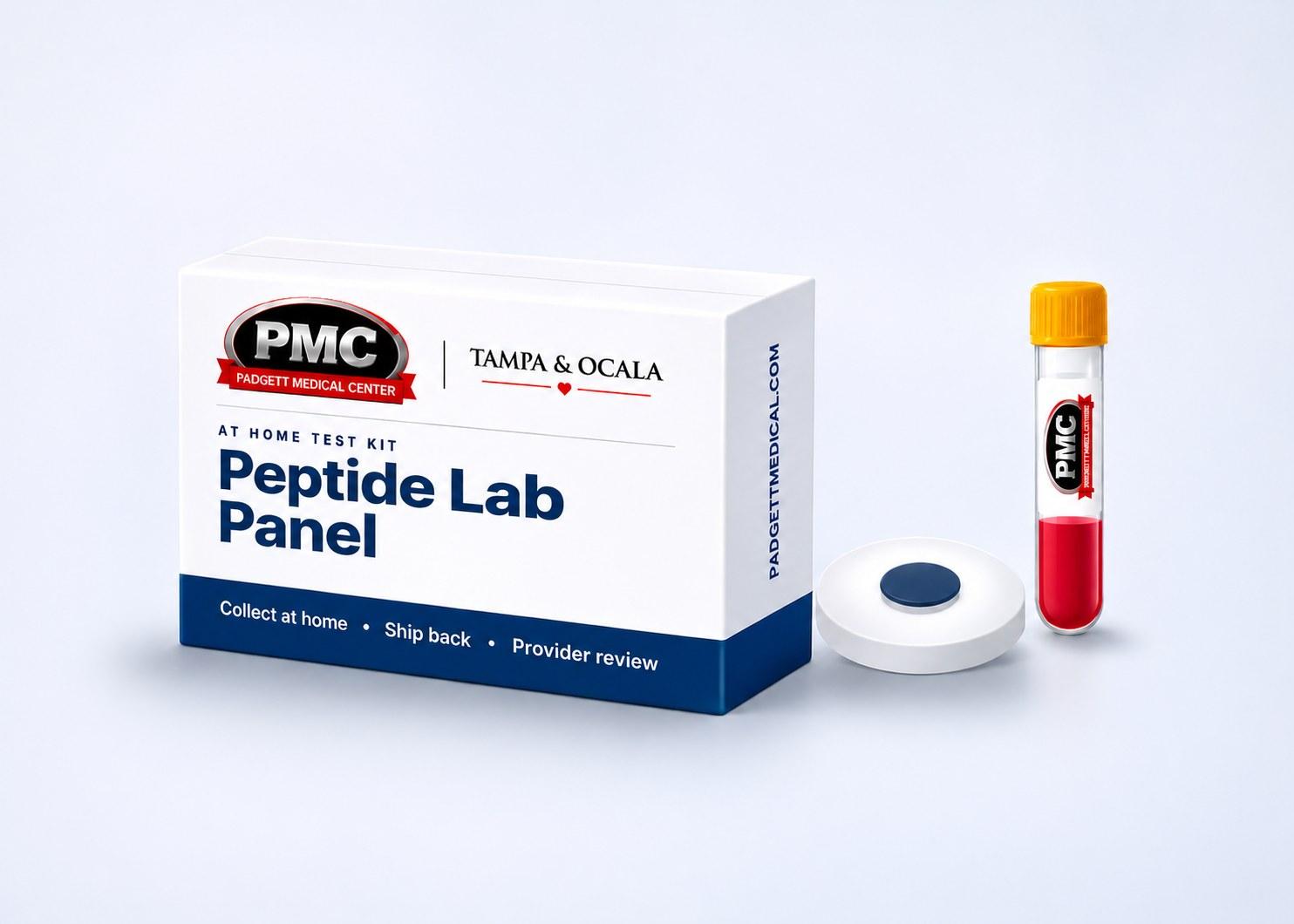
Add-on · At-home lab panel
Peptide Lab Panel
Best for: Patients starting or already on peptide therapy.
Lab testing without the lab visit. 13 tests, collected at home with no needle draw.
Explore your options
BPC-157 questions, answered
Do I need a prescription for BPC-157?+
Yes. At Padgett, BPC-157 is prescribed only after a free visit with a licensed provider who reviews your health, goals and medications. If it fits, a state-licensed pharmacy prepares it for you. A website that sells BPC-157 with no visit and no prescription is not selling a prescription medication.
How long do people take BPC-157?+
There is no standard length, and your provider decides it with you. Your provider checks in on how you are doing, asks what you have noticed, and decides whether to continue, change the form or stop. Never stretch out, restart or refill a course on your own; bring it up at your next check-in.
Can I keep doing physical therapy while taking BPC-157?+
Yes, and most people do. BPC-157 is not a replacement for physical therapy, rest, bracing or the plan your orthopedic or sports medicine provider has given you. Tell each of your providers about the other's plan, so everyone treating your injury knows the full picture of what you take and do.
When will I notice a difference on BPC-157?+
No one can give you a date. People who take BPC-157 describe very different experiences, and some notice little at all. Your provider sets check-ins, listens to what you are seeing, and decides with you whether it is worth continuing. Experiences vary, and no particular result is promised.
Can I take BPC-157 with my other medications?+
Tell your provider about every prescription, over-the-counter medicine and supplement you take before you start. Your provider reviews them at your visit and decides whether BPC-157 fits alongside them. If another doctor adds a new medication later, let your Padgett provider know at your next check-in.
What happens if BPC-157 isn't right for me?+
Your provider tells you so at the visit and explains why, and nothing is prescribed. The visit is free either way. Your provider can also talk through other options at Padgett, such as KPV for gut questions, or point you toward the right kind of care for the problem you came in with.
How much does BPC-157 cost?+
BPC-157 is $12 per capsule or $275 per vial, depending on what your provider prescribes. Your 30-minute provider visit is free, so you only pay for the medication if it is prescribed, and there are no contracts. The only other charge is a $50 no-show fee if you miss the visit without 24 hours' notice.
Free consultation, zero pressure
Take the first step toward feeling your best
Run through a few quick questions and reserve your free consultation, in person in Ocala or by telehealth anywhere in Florida. Most visits land on the same or next business day.
- Your goals reviewed by a real provider
- A plan made for you, never cookie-cutter
- Visit us in Ocala or go telehealth statewide
- A warm, judgment-free team
Important information
BPC-157 is not FDA-approved for any use. It is prescribed only after a visit with a licensed provider and compounded for that patient by a state-licensed pharmacy; it is not a research-grade product. Compounded drugs are not reviewed by FDA for safety, effectiveness or quality before they reach patients. BPC-157 is one of six peptides named in the U.S. Department of Health and Human Services' enforcement discretion policy of October 30, 2026 for compounding pharmacies; that policy is not an FDA approval, and HHS may revisit it if a safety or quality problem arises. BPC-157 is prohibited under the World Anti-Doping Agency's list, so athletes tested under anti-doping rules should not use it. What people report about BPC-157 is not evidence that it works for everyone, and results vary. This page is educational and is not medical advice.
Sources
- FDA Briefing Document: BPC-157-Related Bulk Drug Substances, Pharmacy Compounding Advisory Committee, July 23-24, 2026, U.S. Food and Drug Administration
- Enforcement Discretion Policy Regarding 503A Compounding Using Certain Peptide Bulk Drug Substances, Federal Register, October 30, 2026
- The Prohibited List, World Anti-Doping Agency
- Compounding and the FDA: Questions and Answers, U.S. Food and Drug Administration